
Mindful Compassion
It can require more thought than we might think

Many years ago when I was still working in the library system I had a coworker who routinely tried to dodge out of enforcing certain rules, the most noticeable one being about time limits on the public computers. If we weren’t busy, workstations were unused and nobody on the waiting list, we could allow users more than one hour. If not, we couldn’t. Rather than risking an attempt at debate or disruption, this coworker would try to override the safeguards, then plead fellow staff for understanding. “I’m just so compassionate,” they’d say while bringing hands together in a beseeching gesture and scrunching their face. Since they’d been an actor in a previous career, the theatricality was probably second nature, but for those of us who tended to be more “Apollonian” in temperament, (the Apollonian v. Dionysian types in psychology), at least while at work, the drama grew old quickly.
I liked this person and generally enjoyed working with them, but like all the other staff, I grew tired of playing Bad Cop. And there was something not quite honest about the Compassion excuse. Fear of being in charge and lack of assertiveness didn’t hold up well in a high-volume public service position where a good percentage of the customers had issues that made them likely to become volatile (this library was the downtown branch in a major urban area, with the social challenges that sometimes come with those locales). And real compassion would have included compassion for us coworkers.
I can’t remember where I first read the term idiot compassion - I think it was in a book about mindfulness, one with a Zen Buddhist slant. It’s attributed to the Tibetan teacher Chogyam Trungpa Rinpoche. (See a full article on this here: https://bigthink.com/articles/idiot-compassion-and-mindfulness/) The definition that appeared at the top of my screen was “what happens when we try to be kind at all costs — even if that kindness avoids the truth, reinforces unhealthy patterns, or delays necessary change.” As the Bigthink article points out, we can exercise idiot compassion on ourselves as well as on others.
During the time I was working at the same library our city newspaper ran an article, one of those that discuss the pros and cons surrounding difficult issues, about drivers giving cash to people stationed by freeway exits. A photo showed a woman standing at one of the most-traveled I-5 exits, holding a sign: “Please stop giving meth money to my son.” While no doubt many recipients of cash used it for food or transportation, the mom’s sign illustrated the downside of this practice. Shortly after the article, several churches in the downtown area began assembling and distributing “life packs,” ziploc bags containing emergency rations, bottles of water, city bus tickets and directions on how to reach nearby food banks, shelters and social services. The bags were offered to drivers and pedestrians who wanted to offer some kind of help in passing.
Since shortly after its opening in summer 2013, a nearby store, Main Street Marijuana, has propped several of these signs outside their doors:
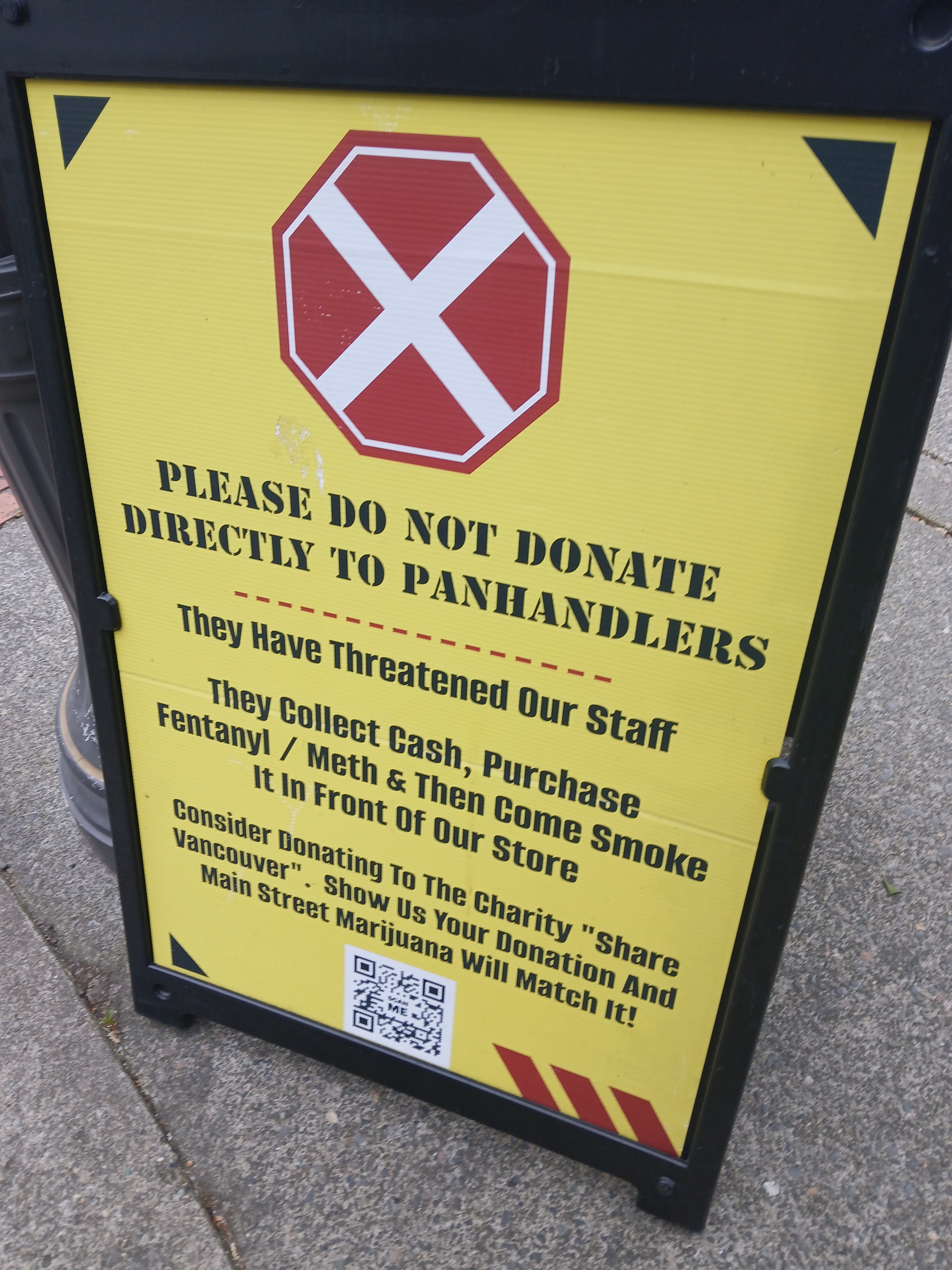
The charity mentioned on the sign is Share House, the umbrella organization that hosts several permanent shelters and a daytime center, complete with permanent housing and employment services, plus providing the professional staff who oversee volunteers working at the winter overflow shelters.
Idiot compassion sometimes plays out in family situations. One such situation with which I’m well familiar, having observed it for 35 years, has had ongoing negative impacts on all involved, including those of us who aren’t of the original family. It took years for the family’s matriarch to stop asking her financially competent children (and by association / joint bank accounts, in-laws) to “lend” money to the spendthrift sibling. This sib is five years older than me but was still treated as the stereotypical baby of the family (although he is the youngest, this role can be played by anyone in any given family regardless of birth order). He has an aptitude for finding long-term cohabitation partners who effectually become his keepers (a certain type of woman is drawn to helpless-seeming men), a situation which gives his older sibs a sense of schadenfreude along with an underlying dread - “What will I do if she kicks him out and he shows up on my doorstep?” Sadly, parents who create this setup by enabling a favorite child usually aren’t aware of the long-term consequences.
Developing a more mindful sense of compassion can be hard because it requires growing the assertiveness to say the necessary “no” without being thrown off balance by possible reactions. In personal / family situations, it can help to offer an idea-based Life Pack, suggestions that include community resources and do-able self-help options. However, it will probably still require learning to live with a certain amount of initial discomfort. Women have historically been the designated accommodators but I’ve also known a number of men who have difficulty setting boundaries.
Another challenge arises from the fact on social media, the people I think of as Proclaimers attract attention and praise by posting weekly reminders of how compassionate they are via the “OMG, I can’t believe the times we’re living in” post. Some of them back this up by volunteering for worthy causes, showing up at rallies (which are weekly events here now), contacting elected officials or other real-world actions. But many don’t. The most reliable activists in my own part of town are quiet folks who rarely talk about themselves at all and who may not be very demonstrative.
We Americans often mistake style for substance, and that includes assuming that high-intensity emoting indicates depth of feeling or committment. Social media has encouraged this by being omnipresent; every world, national or personal event gives an opportunity to grab a spotlight or mic. And with all the racket this generates, only the most dramatic performances will be noticed. Sometimes it seems more about personalities, Likes and followings than about the issues themselves. There’s a misguided sense among some social justice circles that if a person isn’t posting, they’re not doing.
But in spite of all this, sticking with the effort to cultivate mindful compassion as a way of living eventually has its own rewards. One of those rewards is knowing that one’s efforts will have positive results in the long run. Another is a renewed sense of self-respect that comes from not allowing oneself to be manipulated. If the good deed feels “clean,” it’s probably the result of thoughtful, considered compassion. If it makes the doer feel dirty somehow - resentful, ill-used, taken for a ride - it may need rethinking.
This might be the most reliable way to measure an approach: does it bring a sense of rightness, both in the outer-world situation and inside us?